Santa Teresa Costa Rica: The Complete Guide
The road into Santa Teresa is a roughly 40-kilometer stretch of unpaved dirt that begins after you get off the ferry and ends when you run out of land. It’s rutted, dusty in dry season, and a river in rainy season: literally, parts of it flood. Your rental car will wear a permanent layer of red-brown dust within the first hour. You’ll pass through Cobano, a small inland town with the closest reliable ATM, and then the road narrows and the palm trees close in and somewhere in the last few kilometers you catch your first flash of blue ocean through the canopy and you understand immediately why people keep coming back.
Santa Teresa is not a resort destination. There’s no all-inclusive hotel, no casino, no manicured beach promenade. There are surf shops, yoga shalas, Israeli restaurants, and a main road that floods. The electricity goes out occasionally. The internet is fine by surf-town standards but not by Manhattan standards. The waves break clean in dry season and get serious in green season, and on any given morning the lineup has people from Brazil, Germany, Israel, Japan, and about a dozen other countries who all found this corner of Costa Rica’s Nicoya Peninsula and decided to stay longer than planned.
If that sounds like your idea of beautiful coastline, this guide will get you there prepared. If it doesn’t, the next section will save you an expensive mistake.
What Santa Teresa Is Actually Like
First, the geography. Santa Teresa sits on the southern tip of the Nicoya Peninsula, which juts into the Pacific on Costa Rica’s central-west coast. It’s about as remote as you can get on Costa Rica’s Pacific side while still having a working town around you. The nearest city of any size is Nicoya, about two hours northeast on roads that require a 4x4 to take confidently. San José is 5-6 hours by car depending on your ferry timing.
The “town” is really a 10-kilometer strip of surf breaks, restaurants, and small hotels running north from Playa Carmen through Santa Teresa proper and into Mal País. A single main road, mostly unpaved: connects it all. There’s no town square, no historic center, no cathedral. The beach is the center of gravity.
The international surf crowd found Santa Teresa in the late 1990s and never left. Today the community is a genuinely global mix: Costa Rican families who’ve been here for generations, surfers who showed up for a week in 2008 and never booked a return flight, digital nomads working on US or European time zones, yoga teachers doing their third teacher training, and wellness retreat operators who realized that “remote” and “high-end” could coexist at the right price point.
If you’re exploring other Costa Rica beach destinations, compare Santa Teresa to Jacó or Tamarindo to find your perfect spot.
The vibe is relaxed in a way that takes effort to describe. Nobody is rushing. Businesses operate on loose schedules. A “10 AM yoga class” might start at 10:10. Dinner doesn’t really start until 7 PM and goes late. During dry season (December through April), the place gets busy: busy by Santa Teresa standards, which still means nothing like Tamarindo or Jacó, and the restaurants are full and the surf school quads are running all morning. During green season, the crowds thin out, the waves get bigger, the prices drop, and the place reverts to something closer to its off-the-map character.
The honest list of inconveniences, so you’re not surprised:
The roads. Most are unpaved, and the main road through town has sections that wash out badly in rainy season. Parts genuinely flood. In dry season, every passing car or ATV leaves a dust cloud. You will need a 4x4. Full stop.
Power outages happen, especially in green season. They’re usually short, a few hours, but they happen. Any good vacation rental will have backup or inverter systems for critical appliances, but don’t plan a video conference that can’t be rescheduled.
ATMs are unreliable in Santa Teresa itself. You can find one near the Playa Carmen area but it runs out of cash regularly. Bring enough colones or USD from Cobano (which has a Banco Nacional) or from San José if you’re driving through.
Medical facilities are limited. There’s a basic clinic in Cobano. For anything serious (a real emergency, a broken bone that needs imaging) the nearest equipped hospital is in Nicoya, about two hours away. This matters more if you’re traveling with children or anyone with preexisting health conditions.
None of this makes Santa Teresa a bad place to visit. It makes it the kind of place that rewards travelers who planned ahead and punishes the ones who didn’t.
Who Santa Teresa Is Best For (And Who Should Go Somewhere Else)
Go to Santa Teresa if you:
Are a surfer at any level. The waves here cover beginner-to-advanced across a few different breaks. You can spend a week surfing twice a day and not get bored.
Love yoga and wellness. This is one of the highest concentrations of yoga studios, retreat centers, and wellness-focused infrastructure in Costa Rica. You could do morning surf, afternoon yoga, and a massage every day for a week without repeating anything.
Work remotely and want a beach base. Decent internet (most good rentals have fiber or reliable 4G backup), a functioning café scene, and a community of people in the same situation make Santa Teresa workable for digital nomads who don’t need perfect connectivity 24/7.
Want a couple’s trip that’s laid-back rather than scheduled. The rhythm here (morning in the water, afternoon rest, evening dinner) is genuinely restorative. There’s enough to do without it feeling like a full itinerary.
Are specifically looking for a non-resort experience. If you want to feel like you found somewhere, rather than been delivered to somewhere, Santa Teresa has that.
Look elsewhere if you:
Need reliable medical access. The two-hour drive to a hospital is not theoretical: it will matter if something goes wrong, and with young children especially, that’s a risk worth thinking about.
Hate unpaved roads. You will be on them constantly. This isn’t an occasional dirt track to a beach, the main road through town is unpaved. If this bothers you, Santa Teresa will bother you every day.
Want nightlife variety. There are beach bars and a couple of spots that go past 10 PM. There’s not a bar district. This isn’t Jacó or Tamarindo. Santa Teresa goes to bed by midnight.
Expect big-resort amenities. Room service, multiple pools, a spa building, a beach club with wristbands: that’s not what’s here. What’s here is a really good outdoor shower, a small pool, a hammock, and the ocean.
Are on a tight budget. Santa Teresa has gotten expensive. Beach towns in developing countries tend to, and this one has been discovered by enough well-heeled international visitors that prices have adjusted accordingly. You can eat cheaply at a local soda, but mid-range and above options cost real money.
The Neighborhoods: Where to Stay and Why It Matters
The stretch between Mal País in the south and Playa Hermosa (this is a different Playa Hermosa from the one near Jacó. It’s in the Nicoya Peninsula) in the north is referred to collectively as “Santa Teresa,” but each neighborhood has a distinct character. Getting this right affects your whole trip.
Playa Carmen is the commercial hub. This is where the main crossroads sits, where you’ll find the highest concentration of restaurants, surf schools, supermarkets, souvenir shops, and services. The beach break here is long and consistent, with waves that work for beginners and are less intimidating than the sections further north. If you want to be in the middle of the action, the most walkable spot, the most dining options, the easiest access to everything — Playa Carmen is home base. It’s also the busiest, especially in high season.
Santa Teresa proper runs north from Playa Carmen. This is the main surf strip, the breaks get more powerful as you head up, and this section of beach is where the serious surfers set up. The road here has more surf shops, a few notable restaurants, and the kind of residential-meets-commercial mix that tells you people actually live here year-round. The vibe is slightly more local than Playa Carmen, slightly less polished. If surfing is the main reason you’re here and you want to be close to the better waves, stay in Santa Teresa proper.
Mal País is where the road ends and the energy quiets down. This is the oldest part of the area: more fishing village than surf town, and it retains a local, slower character that the areas further north have lost as tourism has grown. The breaks at Mal País and the point at Punta Barrigona are advanced: fast, hollow, and unforgiving. Experienced surfers rate this section highly. The community feels more intimate, and the restaurants and hotels are fewer and generally better chosen because of it. If you’ve been to Santa Teresa before and want something quieter, or if you’re a strong surfer who wants to be at the right breaks, Mal País is worth the extra 15 minutes down the road.
Playa Hermosa (Nicoya Peninsula) sits north of Santa Teresa proper, a few kilometers past the main strip. Less developed, quieter, and a legitimate alternative for travelers who want beach access without the Playa Carmen traffic. The wave here is also good, a beach break that handles swell from multiple directions.
The practical implication: if you’re a first-timer without a strong surf focus, stay near Playa Carmen. If this is your third or fourth trip and you’re chasing waves, look at Santa Teresa proper or Mal País. If you want quiet and don’t mind being slightly more removed, Playa Hermosa or Mal País work.
And wherever you stay, you’ll have a car: you need one here. The distances between neighborhoods aren’t walkable with luggage or groceries.
The Tide Pools: Santa Teresa’s Natural Swimming Holes
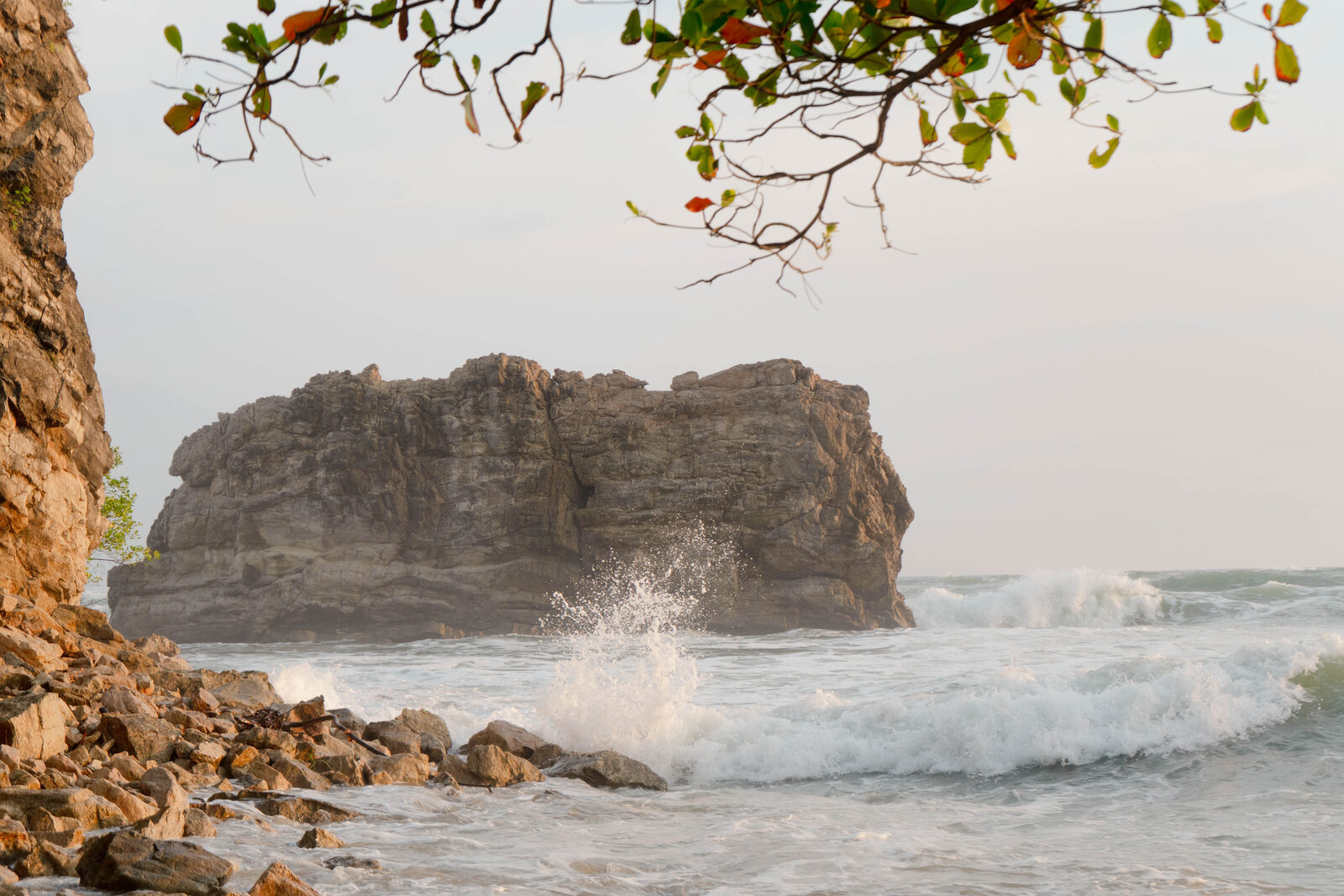
One of Santa Teresa’s best-kept secrets, at least to first-time visitors, is the natural tide pools that form at the north end of Playa Santa Teresa. At low tide, the retreating ocean leaves behind a series of rocky pools deep enough to swim and snorkel in, with clear water and small marine life. Locals call this spot El Peñón.
How to find them: Drive north past the main Santa Teresa strip toward Playa Hermosa. Look for a small parking area on your left near some large rocks sticking out of the sand. That’s El Peñón. The tide pools are scattered among the rocks at the southern end of Playa Hermosa, just before the beach curves.
When to go: Check a tide chart before you head out. The pools only exist at low tide. At mid-to-high tide, the area is just regular ocean with rocks, and swimming here becomes dangerous due to strong currents. Morning low tides are best for calm water and good light for photos.
What to expect: These aren’t the massive natural swimming pools you find in some tropical destinations, but they’re genuinely special. The water is clearer than the main beach (the rocks filter out sand), and you can often see small fish, crabs, and sea urchins in the pools. It’s a completely free activity, popular with families and anyone wanting a break from the wave energy of the main beach.
Pro tips: Bring water shoes – the rocks are slippery and can be sharp. Don’t leave valuables on the beach here; there’s no lifeguard and limited parking lot security. If you visit at sunset, you might have the pools to yourself plus a show.
Getting to Santa Teresa Costa Rica
This is genuinely one of the more involved logistics decisions for a Costa Rica trip, and the options are meaningfully different. Get this right before you book.
Option 1: Drive + Ferry from San José (5-6 hours total, the most common route)
This is how most visitors with rental cars arrive, and it works well if you plan ahead.
Drive Route 27 (the Caldera Highway) from San José toward Puntarenas: about 90 minutes under normal conditions, faster early morning before San José traffic builds. Follow signs to the ferry dock at the tip of the Puntarenas peninsula. The dock is 2 kilometers from the town center, so don’t get lost in town.
Critical: Take the ferry to Paquera, not Naranjo. Both ferries leave from the same dock in Puntarenas, and both go to the Nicoya Peninsula, but they go to different parts. Naranjo is for Sámara and Nosara. Paquera is for Santa Teresa, Mal País, and Montezuma. This is a real mistake people make.
The Naviera Tambor ferry (Puntarenas to Paquera):
There are 8 daily sailings: 4:00 AM, 6:30 AM, 9:00 AM, 12:00 PM, 3:00 PM, 6:00 PM, 10:00 PM, and midnight. Intervals between sailings range from 2.5 to 4 hours (not evenly spaced). The crossing takes about 75 minutes. In peak season (December through April), especially around Christmas and Semana Santa, book your car spot in advance at navieratambor.com or via nicoyapeninsula.com. Popular morning sailings fill up and missing your slot means a long wait or a very late arrival.
Current ferry prices (approximate, 2025-2026):
- Adult passenger: ~$2 USD
- Car + driver: ~$24 USD
- Senior citizens: Free (with ID)
Walk-on passengers can usually board without a reservation. Driving? Reserve your car spot in advance during peak season.
From Paquera, the road south to Santa Teresa is now fully paved — about 53 kilometers, 60 minutes. That said, a 4x4 is still worth having: some hillside side streets and property access roads get muddy and rutted in green season. In dry season, the drive is dusty but straightforward. Either way, take it slow: cattle cross the road, ATVs come fast around blind corners, and the pothole geography on smaller roads changes seasonally.
Total time SJO to Santa Teresa: 5 to 6 hours under normal conditions. Add an hour for San José traffic if leaving Friday afternoon.
Option 2: Shared Shuttle (5 hours, no car required)
Shuttle services like Interbus and Marlin Jack run daily routes from San José (and the SJO airport area) directly to Santa Teresa, handling the ferry logistics for you. Total time is around 5 hours. It’s a comfortable option for travelers who don’t need a car in town (you can rent an ATV or rely on taxis locally) and don’t want to navigate the ferry system themselves. Book in advance during high season.
Option 3: Fly to Tambor (40 minutes flight + 45-minute drive)
Sansa Airlines operates daily flights from San José’s domestic terminal to Tambor. The flight takes about 30-40 minutes. From Tambor Airport it’s a 45-minute drive south to Santa Teresa. Note: Sansa does not fly directly to Santa Teresa or Jacó. The Tambor route is your closest option; alternatively, Sansa flies to Quepos (about a 2-hour drive away via the land route) or Liberia (for Guanacaste).
Current fares run approximately $80-130 USD one way depending on timing and how far in advance you book. Sansa uses small prop planes with strictly enforced luggage limits: 30 lbs checked baggage + 10 lbs carry-on (40 lbs total) is the standard. Pack accordingly. If you’re traveling with a surfboard bag and four checked bags, this isn’t your option. Book at flysansa.com.
The advantage is obvious: you land in the region instead of taking the ferry and driving two hours. The disadvantage: you can’t bring a car, so you’ll need to arrange a transfer from Tambor (your vacation rental manager can usually arrange this or point you to reliable drivers) or rent locally, which is more limited than at SJO.
Option 4: Public Bus + Ferry (6+ hours, cheapest)
It’s possible to reach Santa Teresa entirely by public bus. A bus from San José’s Coca-Cola terminal goes to Puntarenas, from there you walk-on the ferry to Paquera, and another bus runs from Paquera to Cobano and on to Santa Teresa. Total time is around 6 hours. It’s the cheapest option and genuinely workable for light-packing, flexible travelers. Not ideal if you have a lot of gear or a tight arrival schedule.
Option 5: Drive all the way around (6+ hours, no ferry)
There is a land route from San José to Santa Teresa that avoids the ferry entirely by driving south through Puntarenas, then south on the Costanera Sur, then inland to Cobano. It’s longer: 6 to 8 hours depending on traffic, and the roads in the final stretch around the peninsula are rougher. Most people don’t choose this unless they’ve missed the ferry or have ferry anxiety. It’s there if you need it, but ferry + drive is faster and more straightforward for most travelers.
The logistics verdict: If you’re bringing a car and want maximum flexibility, ferry + drive. If you’re traveling light and want to minimize travel time, fly Sansa. Want the easiest experience without a car? Shuttle. Plan around the ferry schedule: the early morning crossings are the most popular for arriving in Santa Teresa before lunch.
For more transportation options across the Central Pacific region, see our Getting Around Costa Rica guide.
The Surf: What to Expect by Season and Level
Santa Teresa is a legitimate surf destination, not a surf-school backdrop. The waves here have character and the break changes significantly by season, so it’s worth understanding before you book your trip around surf.
Dry Season (December through April)
Offshore winds blow in the mornings, cleaning up the wave face. Swells are consistent, typically 3 to 6 feet, and the conditions are the most user-friendly of the year. This is when beginners should come. The water is warm (around 80°F year-round), the lineup is readable, and a week in dry season at Playa Carmen will get most beginners confidently riding unbroken waves by day three.
The tradeoff: dry season is peak tourist season, which means fuller lineups and less elbow room. The really popular breaks at Playa Carmen fill up during Christmas and Semana Santa.
Green Season (May through November)
Swells build through the wet season and the surf gets serious — this is actually when the waves are at their most powerful. Onshore afternoon winds chop up the surface after midday, but mornings are often excellent with head-high-plus sets that intermediate and advanced surfers specifically plan trips around. The rain pattern here is predictable: short, intense afternoon downpours, usually 1–3 hours, not the all-day grey drizzle people expect. Mornings are typically clear. You lose a couple of afternoon hours, not the day.
The crowd drops significantly. A Tuesday morning in September might have four people in the water at a peak that would have fifteen in February. Rain and waves arrive together; that’s the deal.
The break breakdown:
- Playa Carmen: Longest, most forgiving beach break. Multiple peaks spread out the crowd. Best for beginners and longboarders. Works on small-to-medium swell.
- Santa Teresa proper: More powerful, faster wave. Beach break that gets hollow at higher tide. Good for intermediate surfers. Consistent year-round.
- Mal País and Punta Barrigona. This is where it gets serious. A fast, hollow right-hand point break that advanced surfers rate highly. Not forgiving. Not for beginners. But when it’s working, it’s exceptional.
Water temperature stays around 80°F all year: you don’t need a wetsuit, and most people surf in a rash guard or boardshorts.
For a broader view of surfing along the coast, see our Central Pacific Surfing Guide or Jacó Surfing Guide.
Every surf school in the area operates at Playa Carmen. Lessons run $50-70 for a two-hour group session with board rental, $80-100 for a private lesson. Most schools also rent boards by the day ($15-25 for a soft-top, more for fiberglass shortboards). If you want to progress past beginner level during your trip, commit to going out twice a day: morning for the clean conditions, late afternoon for the crowd-free windows.
Explore our Santa Teresa surf guide → | All surfing activities in Costa Rica →
Yoga and Wellness: The Other Reason People Come
Santa Teresa has one of the most serious wellness scenes in Costa Rica. This didn’t happen by accident, the combination of remote setting, natural beauty, and surf culture created a community that gravitates toward yoga, raw food, meditation, and the kind of intentional living that’s hard to maintain at home but feels natural here. Multiple yoga studios, retreat centers, and individual teachers operate here, and the scene is genuine rather than performative.
The studios you’ll actually find:
Horizon Hotel & Yoga Center sits on a hillside above the main road in Santa Teresa, surrounded by jungle with ocean views. It’s been operating since the early 2000s: one of the original yoga centers in the area. The owners completed teacher training at the Sivananda ashram and have been teaching here since 2003. Classes are primarily Sivananda-style hatha yoga: structured, traditional, focused on pranayama and asanas in sequence. Drop-in classes are available; the setting is genuinely beautiful, a hilltop shala with cross-breeze, the sound of the ocean below, and no traffic noise.
Pranamar Villas takes the setting to an extreme: their yoga shala sits directly on the white sand of Santa Teresa beach. This is beachfront yoga as the phrase should mean: not a studio with an ocean view, but an open-air platform with your feet in the sand and waves in your peripheral vision. They run regular drop-in classes and also host multi-day retreats for groups.
Indigo Yoga Resort (formerly Beija Flor) operates in a flat, grassy garden setting, the kind of open tropical studio that makes people describe it as “like Bali.” The pool is excellent, and many people do a yoga class followed by time in the water and a meal at the restaurant, which treats it as a half-day wellness reset.
Drop-in class prices: $15-20 USD per session is the typical range across studios. Retreats vary widely: a 5-7 night all-inclusive surf and yoga retreat runs $1,000-3,000 USD depending on accommodation quality and what’s included. Pura Vida Adventures runs well-regarded all-inclusive retreats in Santa Teresa with daily surf instruction and yoga, accommodation, and most meals included.
The itinerary that actually works:
7:00 AM: Paddle out at Playa Carmen for the offshore morning sesh. The lineup at this hour is half the size it’ll be by 9 AM. 9:30 AM: Return, rinse off, eat a serious breakfast (açaí bowl, fresh fruit, eggs (all available at the cafés near the main road). 11:00 AM) If you’re still going, paddle back out. Or rest. 4:30 PM: Yoga class at Horizon or Pranamar for the late afternoon session. The heat has peaked, the offshore winds have shifted, and your body is tired from the morning surf in the best possible way. 6:30 PM: Sunset somewhere near the beach, ideally with a cold Imperial or a tamarind margarita. 7:30 PM: Dinner.
This isn’t a theoretical itinerary. This is what a lot of people who come to Santa Teresa for a week actually do, and they leave talking about it for months.
Where to Eat in Santa Teresa
The food scene here is genuinely international and better than the remote location would suggest. Israeli, Italian, Asian fusion, raw/vegan, and Costa Rican sodas all operate within the main strip. The quality-to-price ratio is not Jacó (Santa Teresa is more expensive for equivalent food), but there are excellent meals at multiple price points.
The standbys:
Manzú (the beachfront restaurant at Hotel Nantipa) is the most consistently excellent dinner option in the area, serving what you’d call refined Costa Rican cooking with Mediterranean influence. Open to non-guests. The Pura Vida tasting menu is worth doing at least once. It’s the most expensive spot on this list ($30-40/person for dinner), and it’s worth it for a night when the setting and quality matter.
Katana Asian Cuisine does Asian fusion with a Balinese-style open-air design. Dinner only. Bao, wok dishes, sushi rolls: not the kind of thing you’d expect in a remote surf town, and genuinely well-executed. Main courses run $15-22. Call ahead or show up early in high season because it fills up.
Zula is the Israeli restaurant that regulars keep returning to. Open since 2004 (one of the oldest spots on the strip) the hummus is made fresh daily and the shakshuka arrives in a cast-iron skillet. If you’ve eaten your way through every Israeli restaurant in Tel Aviv and ended up in Santa Teresa instead (which several of the regulars apparently have), Zula will feel like home. Falafel, pita, mezze plates: good value at $12-18 for a meal.
El Patio Café is where you have breakfast. The Gaston sandwich with a banana iced coffee has its own following. Prices are reasonable, the crowd is relaxed, and the terrace has just enough dappled light in the morning to make you feel like you made excellent life decisions.
Ani’s Bowls has become a local favorite for healthy breakfast and lunch. Açaí bowls, smoothies, and strong coffee in a casual setting near Playa Carmen. Popular with digital nomads and surfers.
Satori Terrace Sushi Bar is consistently rated as one of the best sushi spots in the area. Fresh fish, creative rolls, and a rooftop setting that catches the ocean breeze.
Al Chile Viola serves Italian cuisine in a garden setting. Pasta, wood-fired pizzas, and generous portions. A solid option when you need a break from fish and tacos.
Drift specializes in vegan and vegetarian fare with a focus on organic, locally-sourced ingredients. The veggie burger and acai bowls draw consistent praise, and the cocktails are creative.
There are a couple of solid bakeries in and around the Playa Carmen area: good coffee, excellent pastries, whole-grain breads that you’ll fill your rental fridge with for the week. Ask locally when you arrive because these places open, close, and rename with some regularity, and whatever’s there in your week will be worth finding.
Banana Beach Restaurant is a beach bar rather than a serious dining destination: excellent for sunset cocktails, a plate of something light, and watching the surfers work the break in front of you. Go for the setting and the drinks, not specifically for dinner.
Local sodas still exist in and around Cobano and on the edges of the main strip. A casado (the Costa Rican plate of rice, black beans, plantains, salad, and protein) runs $7-10 and is excellent, especially at the sodas that have been there since before the international crowd arrived. Ask locally for current recommendations because these places don’t advertise.
Price reality check: budget $10-15 for a casual lunch, $20-35 for a proper dinner with drinks. It’s higher than the rest of rural Costa Rica but not out of line with what you’d pay at a good restaurant in a US or European city.
Nightlife
Santa Teresa’s nightlife is beach bar culture, not club culture. This is by design, the people who live here and the travelers who seek it out largely prefer the former. If you came for nightlife variety, you’re in the wrong place and the Jacó guide will be more useful to you.
What you get: sunset cocktails at Banana Beach or the beach bars along the main strip. A few spots with live music on weekends: local bands, reggae sets, the occasional DJ. Kika Beach Club has historically been the liveliest spot in the area, with a party atmosphere that goes later than most, outdoor dance space, and a crowd that actually dances. It’s the one place in Santa Teresa that approximates a night out.
Mostly, though, a night out here is: dinner until 9 or 9:30 PM, drinks after, home by midnight or 1 AM. The town wakes up early for the surf and goes to bed at a reasonable hour, and the social scene reflects that. If you’re the kind of person who prefers a long dinner with good wine over a loud club, you’ll be happy. If you need a late-night scene with options, this specific corner of the world is not built for that.
Safety in Santa Teresa
Santa Teresa is safe. That’s the honest answer. It’s a tourist-friendly town with a tight-knit international community and very low serious crime. Standard common sense applies — don’t leave valuables in your car, don’t flash expensive gear on the beach — but this isn’t a place with a street crime problem or the kind of security infrastructure anxiety you get in some busier tourist corridors.
The specific things to actually watch for:
Rip currents. This is the real safety issue in Santa Teresa. The beach breaks here can produce strong, fast rip currents, especially during larger swells and on incoming tides. If you’re not a strong ocean swimmer, don’t go past your knees without a local’s guidance. If you get caught in a rip: don’t fight it directly back to shore (you’ll exhaust yourself). Swim parallel to shore until you’re out of the current, then angle back in. All the surf schools cover this on day one, and it’s worth the 10-minute lecture even if you think you know it.
Driving at night on unpaved roads. This sounds minor until you’ve done it once. The combination of no streetlights, deep ruts, cattle on the road, ATV riders without headlights, and unfamiliar pothole patterns makes nighttime driving on the unpaved main road genuinely hazardous. Drive slowly. If you’ve had drinks, take a taxi. This kills more vacation plans than any other single factor in remote Costa Rica beach towns.
Petty theft from cars. Don’t leave anything visible in your car, especially at beach parking spots. Smash-and-grab isn’t rampant in Santa Teresa the way it can be in some busier Costa Rican beach towns, but the risk exists. Empty your car every time you park at the beach. Use the safe in your vacation rental for passports, extra cash, and electronics you’re not carrying.
Limited medical infrastructure. There’s a basic clinic in Cobano (15 minutes from Santa Teresa). The nearest equipped hospital is in Nicoya, two-plus hours away. For a life-threatening emergency (major trauma, cardiac event) evacuation to San José would be required. This is not a reason not to come. It’s a reason to have travel insurance with medical evacuation coverage. If you’re traveling with young children or anyone with serious health conditions, think carefully about what this means for your specific situation.
Water safety: The tap water in Costa Rica’s Pacific coastal towns can be variable. Most well-managed vacation rentals provide filtered water. Bottled water is inexpensive and available everywhere. In any place of uncertainty, drink bottled.
Practical Information
Getting cash: This is not optional to plan. The ATMs in Santa Teresa proper are small, run out of cash regularly, and sometimes just don’t work. Stop at the Banco Nacional in Cobano and take out what you’ll need for the week before you get to Santa Teresa. Cobano is about 15 minutes from Playa Carmen on the road you’re already taking. USD is widely accepted in restaurants, surf schools, and hotels, but for local sodas, small shops, and small purchases, you’ll want colones. The exchange rate you’ll get paying USD in a tourist shop is never favorable.
Vehicle: A 4x4 is strongly recommended year-round and essentially mandatory in green season (May through November). Don’t book a 2-wheel-drive compact and assume it’ll be fine, the roads will prove you wrong, often at the worst possible moment (midway to Mal País in the rain). Reserve a 4x4 from your car rental agency before you arrive; availability at the Tambor airport is limited.
Groceries: The main strip has small markets for basics. For serious grocery shopping, Mega Super in Cobano is the primary option: reasonable selection, normal Costa Rican supermarket prices. If you’re stocking a vacation rental kitchen for a week, do a Cobano run on arrival day. There’s no AutoMercado-level supermarket in the Santa Teresa/Mal País area.
Cell coverage: Kolbi has the best network coverage in this part of the peninsula. Claro works too but has more dead zones. Buy a Kolbi SIM at the SJO airport before you make the drive; $10-15 gets you enough data for a week. Coverage is decent in the main Playa Carmen and Santa Teresa strip, spotty in some of the hills above town, and inconsistent in Mal País.
WiFi: Most vacation rentals have WiFi these days, and quality varies significantly. Good properties have fiber connections or 4G backup. Ask specifically about upload speeds if you need to be on video calls: download speeds can look fine while upload is unusable. Pre-arrival, ask your rental manager what the situation actually is.
Tipping: 10% service charge is legally mandated in Costa Rican restaurants and is included in your bill. Some places include it, some add it separately: check your bill. Additional tips beyond the mandatory 10% are welcome but not required. Tip surf instructors, tour guides, and service staff separately: they appreciate it.
Currency: Colones (CRC) are the national currency. USD is widely accepted, especially in tourist-facing businesses, but don’t assume you’ll always get good rates. ATM withdrawals in colones give you the bank rate; paying in USD means the business sets the rate.
Day Trips from Santa Teresa
You’re on the southern tip of the Nicoya Peninsula, which puts you within reach of a few places worth a dedicated day trip.
Montezuma Waterfalls: About 45 minutes northeast of Santa Teresa on the road toward Cobano. Montezuma is a small beach and waterfall town with the kind of earthy, backpacker-original energy that Santa Teresa has lost a bit of as it’s gotten more expensive. The main waterfall drops into a jade pool where you can swim. It’s genuinely beautiful. Walk the river trail (it’s marked; 20-30 minutes from the main beach). The town itself has inexpensive food, a few beach bars, and a different social mix than Santa Teresa.
Cabo Blanco Nature Reserve: 10 kilometers south of Mal País, at the absolute tip of the peninsula. This is Costa Rica’s first protected area: established in 1963 and still one of its best. The reserve covers 3,000 acres of forest and coastline, with hiking trails to Playa Cabo Blanco, a remote beach that requires the 2-hour roundtrip hike to reach (making it reliably uncrowded). Wildlife: monkeys, sloths, coatimundis, over 150 bird species. Open Wednesday through Sunday, 8 AM to 4 PM. Entrance fee around $12/person. Worth it.
Isla Tortuga. A full-day catamaran or boat trip from the Paquera area (an hour from Santa Teresa), Isla Tortuga is the idealized version of a Pacific island: clear turquoise water, white sand, and the kind of snorkeling that makes people rethink their life choices about where to live. Day trips run $80-120/person and typically include transportation, snorkeling, lunch, and drinks. Several operators run this from the Santa Teresa area: ask at your rental or at the tour shops in Playa Carmen.
Finding a Place to Stay
The rental scene in Santa Teresa has matured significantly in the last several years. You’ll find everything from basic surf shacks to properly managed luxury villas with private pools, plunge pools, and views that make the price feel reasonable. The quality of management matters enormously in a remote location like this, a poorly maintained property with a broken generator and no one to call is a much worse version of a problem than the same issue in Jacó.
What to look for: a property manager with actual local presence (not a booking platform with a 48-hour response time), backup power or generator for outages, reliable vehicle access (gated parking if your car has gear in it), and honest description of the road condition to reach the property. Some villas are on steep unpaved tracks that require real 4x4 experience in wet season (ask before you book).
If you want concierge support, airport transfer arrangements, grocery pre-stocking, and tour booking, that’s the difference a full-service property management company makes. Nest Stays doesn’t currently manage rentals in Santa Teresa, but our Central Pacific homes pair well with a few days here. Explore Nest Stays destinations →
When to Go: The Seasonal Calendar
Santa Teresa’s two seasons create genuinely different trips, and picking the right one for you matters more than most travel decisions.
Dry Season (December through April)
This is when most people visit, and for good reason. Rain is rare. Mornings are clear and hot, with offshore winds that groom the surf into clean, glassy faces. Afternoon temperatures hit 32-34°C (90-93°F) with low humidity compared to green season. The ocean stays around 27-28°C (80-82°F) year-round, so water temperature isn’t a factor either way.
Surf conditions favor beginners and intermediates. Swells run 3-6 feet, consistent and readable. The breaks at Playa Carmen are at their most approachable. Experienced surfers will find fun waves but not the power that green season delivers.
The town is at full energy. Every restaurant is open, yoga studios run full schedules, the beach bars have music, and the sunset crowd fills the sand every evening. The flip side: it’s the most crowded the area gets. Rental rates are at their peak. The popular breaks have fuller lineups. Christmas week, New Year’s, and Semana Santa (Easter week) are the absolute busiest periods, with rates 40-60% higher than shoulder season and minimum stays of 5-7 nights at most properties.
If you’re coming in dry season and want to avoid the worst crowds, aim for January after the New Year’s rush clears (second week onward) or late March before Easter. February is consistently busy but not holiday-peak busy.
Green Season (May through November)
“Rainy season” is the technical term, but it undersells what’s actually happening. Mornings are almost always dry and often spectacular: clear skies, warm light, calm water. The rain arrives in the afternoon, typically between 2 and 5 PM, as a proper tropical downpour that lasts one to three hours and then clears. This is not all-day rain. You lose a few afternoon hours. By sunset, the sky is often dramatic with post-storm color.
Surf gets serious. Swells build to overhead and double-overhead on the bigger days, and the swell energy actually increases through the wet season as Pacific storm activity picks up. The breaks at Santa Teresa proper and Mal País come alive with powerful, fast waves that intermediate and advanced surfers specifically time their trips for. Morning sessions before the onshore wind picks up around 10-11 AM are the window. If you’re chasing the best surf Santa Teresa offers, this is your season.
Crowds drop significantly. A Tuesday morning in September might have four people in the water at a peak that would have fifteen in February. Restaurants are quieter, roads are emptier, and the town shifts to a more local, residential rhythm. Some smaller businesses close or reduce hours, but the main restaurants, yoga studios, and surf schools operate year-round.
Pricing reflects the lower demand. Vacation rental rates drop 20-30% compared to peak dry season. You can stay in a property in green season for what a lesser property costs in February. Flights to Costa Rica are cheaper. The ferry is less crowded. Everything is more relaxed.
The trade-offs are real: the roads get worse (standing water, deeper ruts, mud on smaller tracks), power outages are more frequent, and the humidity is higher. Pack accordingly and drive carefully. But if you’re flexible and don’t need guaranteed sunshine every afternoon, green season delivers a better-value, less-crowded, more powerful version of Santa Teresa.
The Verdict
First-timers who want the full experience with minimal weather risk: come in dry season, but avoid the holiday peaks. Surfers who want the best waves: green season, specifically August through October. Budget-conscious travelers: May, June, or November. The “sweet spot” months that balance weather, crowds, and cost: late November (just before peak season kicks in) or early May (rain hasn’t fully set in yet, prices have already dropped).
For a month-by-month breakdown of Costa Rica weather, see our Best Time to Visit Costa Rica guide.
What It Actually Costs: A Santa Teresa Budget Breakdown
Santa Teresa isn’t cheap. It’s a remote international surf town where imported goods travel by ferry and the clientele skews toward travelers with disposable income. That said, there’s a wider price range than most guides acknowledge.
Daily Budget by Travel Style
Budget ($50-80/day per person): Stay in a hostel dorm or split a basic rental with friends. Cook most meals from groceries bought at Mega Super in Cobano. Eat at local sodas for lunch (casados run ₡4,000-6,000, roughly $7-10). Surf with your own board or rent a soft-top for $15-20/day. Skip the cocktail bars. This is doable but requires discipline in a town where a single açaí bowl costs $12.
Mid-range ($150-250/day per person): Private vacation rental with a pool, split between a couple or small group. Breakfast at the rental, lunch at a café ($12-18), dinner at a proper restaurant ($25-40 with a drink or two). One or two paid activities per day: a surf lesson, a yoga drop-in class, a day trip. A rental car. This is the sweet spot for most visitors.
Luxury ($300-500+/day per person): A well-managed villa with ocean views, private pool, and concierge service. Meals at the better restaurants (Manzú, Katana). Private surf instruction. Daily yoga. Spa treatments. A driver or high-end 4x4 rental. This level of spending buys a genuinely excellent experience in Santa Teresa, and it’s still less than equivalent quality in Bali or Hawaii.
Specific Costs to Plan Around
Restaurants: A meal at a local soda runs $7-10. A café lunch (sandwich, bowl, smoothie) is $12-18. Dinner at a mid-range restaurant is $20-35 per person with one drink. The top-end spots (Manzú at Hotel Nantipa) run $35-50 per person. A beer at a beach bar costs $3-5. A cocktail is $8-14.
Surf lessons: Group lessons (2 hours, board included) run $50-70. Private lessons are $80-120. Board rental alone is $15-25/day for a soft-top, $25-40 for a fiberglass board.
Yoga: Drop-in classes at the established studios cost $15-20 per session. Multi-class packages bring it down to $10-15 per class. Full retreat packages (5-7 nights with accommodation, meals, daily yoga, and sometimes surf) range from $1,000 to $3,000+.
Tours and activities: Cabo Blanco Nature Reserve entrance is about $12. An Isla Tortuga day trip runs $80-120. ATV rentals go for $60-100/day. Horseback riding on the beach is $50-80. Snorkeling tours are $50-70.
Transportation: Car rental (4x4 SUV from SJO airport) runs $50-90/day depending on season, insurance options, and how far ahead you book. The Naviera Tambor ferry costs around $24 for a car with driver, roughly $2 for walk-on passengers. A Sansa flight from SJO to Tambor is $80-130 one way. Local taxis within the Santa Teresa area charge $5-15 depending on distance. ATV rental for getting around town runs $40-70/day.
Groceries: A week of self-catering groceries from Mega Super in Cobano costs roughly $80-120 for a couple, depending on how much you’re cooking versus eating out. Fresh produce, rice, beans, eggs, chicken, and beer are all reasonably priced. Imported items (good cheese, wine, specialty products) cost significantly more than in San José or at home.
Getting There and Getting Around: The Full Logistics
The journey to Santa Teresa is part of the experience. It’s also the part that goes wrong most often when people don’t plan it.
From SJO Airport: Your Two Real Options
Option A: Drive + Ferry (5-6 hours, best for flexibility)
This is the standard route and the one that gives you a car for your entire stay, which you’ll need.
- Pick up your 4x4 rental at SJO airport. Major agencies (Adobe, National, Budget, Alamo) all have desks there. Book a 4x4 or high-clearance SUV. Not a sedan. Not a compact crossover. A proper 4x4.
- Drive Route 27 (Caldera Highway) west toward Puntarenas. About 90 minutes under normal conditions, faster early morning.
- Take the Naviera Tambor ferry from Puntarenas to Paquera. The crossing takes 75 minutes. Book your car spot in advance at navieratambor.com during peak season (December through April); the early morning crossings sell out. Car with driver costs around $24 one way; walk-on passengers pay about $2.
- Drive from Paquera south to Santa Teresa: about 60 minutes on fully paved main road.
Timing tip: If you’re landing at SJO in the morning, you can realistically make a late-morning or midday ferry. If you land afternoon or evening, stay near SJO or Puntarenas and take an early ferry the next morning. The drive from Paquera to Santa Teresa in the dark is not recommended, especially if you don’t know the road.
Option B: Fly to Tambor (fastest, but no car)
Sansa Airlines flies SJO to Tambor daily. The flight is 30-40 minutes. From Tambor Airport, it’s a 45-minute drive to Santa Teresa. Fares run $80-130 one way. Luggage limit is strict: 30 lbs checked + 10 lbs carry-on (40 lbs total). If you’re traveling light and plan to rent a car locally or arrange transfers through your property manager, this saves hours.
The downside: fewer car rental options at Tambor than SJO, and local availability can be tight in high season. Book your local rental well in advance, or arrange airport transfers and rely on ATV rental in town.
Car Rental: What You Need to Know
Book a 4x4 from a reputable agency at SJO. Adobe Rent a Car is Costa Rica’s largest local agency and generally gets good reviews for service and vehicle condition. International chains (National, Alamo, Budget) are also reliable. Expect to pay $50-90/day for a proper 4x4 SUV including basic insurance.
Insurance: Costa Rica requires mandatory liability insurance (SLI/TPL), which is included in your rental or added at the counter. Optional collision damage waiver (CDW) and extended coverage are strongly recommended for the Santa Teresa roads. Some credit cards cover CDW if you decline the rental agency’s coverage, but verify this before you travel. Rental agencies will try to sell you maximum coverage at the counter. Decide what you want before you arrive.
Fuel: Fill up in Puntarenas before the ferry or in Cobano on the way in. There’s a gas station in Cobano. Fuel prices in Costa Rica hover around $1.20-1.40/liter (roughly $4.50-5.30/gallon). A full tank in a mid-size SUV will last a week if you’re staying local.
What to Pack for Santa Teresa
The standard Costa Rica packing list applies, but a few things are Santa Teresa-specific:
Reef-safe sunscreen in quantity. You’ll use more than you think. The equatorial sun is intense, and you’re in the water twice a day. Bring enough for your whole trip because the local shops charge tourist prices.
A headlamp or small flashlight. Power outages happen, the roads have no streetlights, and you’ll need it for walks after dark. Your phone flashlight works but drains battery.
Dust-proof bags for electronics. Dry season means fine red dust gets everywhere. A ziplock or dry bag for your laptop, camera, and phone while driving is worth the effort.
Rain jacket (green season) or light layer (dry season evenings). Green season afternoon downpours are warm but sudden. Dry season evenings can cool down enough that a light layer feels good after a day in the sun.
For a complete packing list tailored to Costa Rica’s climate, see our Costa Rica Vacation Packing List.
Water shoes or sturdy sandals. The beach has rocky sections, and you’ll be walking on uneven surfaces constantly. Flip-flops work for the beach but not for exploring.
Your own surf rash guard. Rental rash guards exist but are often questionable. Bring your own if you’re surfing daily.
A reusable water bottle with a filter. Reduces plastic waste and means you’re never without drinkable water, even when the local water quality is uncertain.
Currency, ATMs, and Paying for Things
The national currency is the Costa Rican colón (CRC). As of early 2026, the exchange rate sits around 505-515 colones to 1 USD, though this fluctuates.
ATMs: The ATMs near Playa Carmen are your only option in the Santa Teresa area. They accept international cards (Visa/Mastercard, sometimes Amex) but have daily withdrawal limits (typically ₡200,000-300,000, roughly $400-600) and run out of cash during busy periods. The reliable move: withdraw what you’ll need at Banco Nacional in Cobano on your way in.
Credit cards: Most established restaurants, hotels, and surf schools accept Visa and Mastercard. Amex acceptance is less common. Smaller shops, local sodas, and some activity operators are cash-only. Card terminals occasionally lose connection (the internet here has its moments), so always carry some cash as backup.
USD: Widely accepted at tourist-facing businesses, but you’ll get a worse exchange rate than the bank rate. Use USD in a pinch, not as your default payment method. For the best value, pay in colones.
Tipping: A 10% service charge is mandatory in Costa Rican restaurants and appears on your bill. Tipping beyond that is appreciated but not expected. Tip surf instructors, drivers, and tour guides separately in cash.
A Few More Things Worth Knowing
High season is real and crowded. Christmas, New Year’s, and Semana Santa (Easter week) are when Santa Teresa gets as close to full as it gets. Rental rates spike 40-60%. Restaurants are full. The waves are crowded. Book rental cars, ferries, and accommodation months in advance if you’re coming during these windows. The ferry on the weekend before Christmas is not a place you want to discover you forgot to book a car spot.
Green season is underrated. May through November gets dismissed as “rainy season” in a lot of Costa Rica content, and the dismissal is lazy. Yes, it rains. A proper tropical downpour most afternoons, usually 1-3 hours, usually clearing by evening. Mornings are often spectacular. The waves are better. The crowds are gone. Prices drop 20-30%. The landscape is shockingly green. If you’re an intermediate surfer and you’re flexible on timing, May or October are worth serious consideration.
For more details on traveling during green season, read our Costa Rica Rainy Season Travel Guide.
The people you meet here are a self-selecting group. Everyone who makes it to Santa Teresa put in the effort to get there, the ferry timing, the road, the remoteness that filters out travelers who want convenience. This makes the social atmosphere at the beach, in the restaurants, and in the surf lineup noticeably better than places that are easier to reach. People are there on purpose.
Don’t fight the pace. The thing that frustrates some visitors about Santa Teresa, the loose schedules, the businesses that close when the owner wants to surf, the restaurant that’s “open from 6 but maybe 7” — is the same thing that makes it restorative. If you arrive with a packed daily agenda and a need for things to run on time, you’ll spend a week being frustrated. If you arrive with the first day for decompression and the second day’s surf time written down and everything else up for revision, you’ll find that Santa Teresa delivers something you didn’t know you needed.
Santa Teresa rewards travelers who show up knowing what it is. Remote, a little rough around the edges, genuinely beautiful, and full of people who found something here they couldn’t replicate anywhere more convenient. The road in washes out in the rain and the ATM runs out of cash and the power goes out sometimes, and none of those things matter much when you’re in the water at 7 AM watching a set wave roll in and the whole lineup drops in together and the pelicans are flying parallel to the break and the sun is still low enough to be golden.
Thinking about a Santa Teresa trip? Start with our Santa Teresa destination overview, then pair it with a few days on the Central Pacific in a Nest Stays home. Comparing destinations? See our Jacó area guide and best time to visit Costa Rica.
- https://navieratambor.com/horarios-y-tarifas (Ferry schedules and prices)
- https://nicoyapeninsula.com (Ferry booking alternative)
- https://www.twoweeksincostarica.com/mal-pais-tide-pools/ (Tide pools location)
- https://enchanting-costarica.com/tours-and-activities/swimming-pool-ocean-santa-teresa-costa-rica/ (Tide pools details)
- https://www.livelikeitstheweekend.com/best-restaurants-santa-teresa-costa-rica/ (Restaurant recommendations)
- https://costaricatravellife.com/restaurants-in-santa-teresa-costa-rica/ (Restaurant recommendations)
- https://www.tripadvisor.com/Restaurants-g635538-Santa_Teresa_Province_of_Puntarenas.html (Restaurant reviews)
- https://costaricaexperts.com/destinations/santa-teresa/ (Things to do, yoga, fishing)
- https://weareglobaltravellers.com/2021/05/best-things-to-do-santa-teresa/ (Activities, Eat Street, ATV rental)
- https://flysansa.com (Flight information)
- Pre-verified data provided by strategist (ferry schedule, road condition, green season details, Sansa routes)
Frequently Asked Questions
What is the best time to visit Santa Teresa, Costa Rica?
Dry season (December through April) gives you guaranteed sun, smaller surf, and the liveliest town atmosphere. Green season (May through November) brings afternoon rain showers, bigger waves, far fewer crowds, and rental rates typically 20–30% lower than peak. First trip with no surf agenda: come dry season. Surfers and value-seekers: green season delivers more wave and more bang for your budget.
Do I need a 4x4 in Santa Teresa?
Yes. The main road through town is partly unpaved, side roads to hillside properties are steep and rutted, and in green season many roads flood or wash out. A standard sedan will get stuck. Book a 4x4 SUV from your rental agency at SJO airport before you arrive.
How do you get from San José to Santa Teresa?
Three real options: (1) Rental car + Naviera Tambor ferry from Puntarenas to Paquera, then drive south — about 4–5 hours total driving plus 75 minutes on the ferry, roughly 5–6 hours door to door. (2) Shared shuttle — services like Interbus or Marlin Jack run SJO to Santa Teresa in around 5 hours with the ferry included; comfortable and no navigation required. (3) Public bus + ferry — the cheapest option at roughly 6 hours total, with a bus to Puntarenas, the Paquera ferry, and a connecting bus to Cobano and Santa Teresa. Sansa Airlines also flies SJO to Tambor in 30–40 minutes; from Tambor it’s a 45-minute drive to Santa Teresa.
How much does a trip to Santa Teresa cost per day?
Budget travelers spending on hostel dorms, local sodas, and cooking can get by on $50-70 per day. Mid-range travelers in a private rental with restaurant meals should budget $150-250 per day. Luxury villa stays with dining out, surf lessons, and yoga classes run $300-500+ per day, per person.
Is Santa Teresa safe for tourists?
Yes — Santa Teresa is a tourist-friendly town with a tight-knit international community and low serious crime. The main concerns are rip currents in the ocean, driving on unpaved roads at night, and petty theft from parked cars (don’t leave valuables visible). The nearest hospital is in Nicoya, about two hours away, so travel insurance with medical evacuation coverage is recommended.
Are there ATMs in Santa Teresa?
There are ATMs near Playa Carmen, but they run out of cash regularly during busy periods. Withdraw colones at Banco Nacional in Cobano before arriving in Santa Teresa, or bring USD as backup. Most restaurants accept credit cards, but smaller shops and local sodas are cash-only.
What are the best tide pools in Santa Teresa?
The famous Santa Teresa tide pools form at low tide near the rocks at the north end of Playa Santa Teresa (known as El Peñón). They’re deep enough to swim and snorkel in, with clear water and marine life. Access is easiest by parking near the rocks at the southern end of Playa Hermosa and walking. Go at low tide only – the pools disappear completely at high tide.
Ready to Experience Santa Teresa Costa Rica: The Complete Guide?
Book your Costa Rica vacation rental with Nest Stays and make this your base for it all.