Costa Rica Real Estate Investment Guide for Rentals
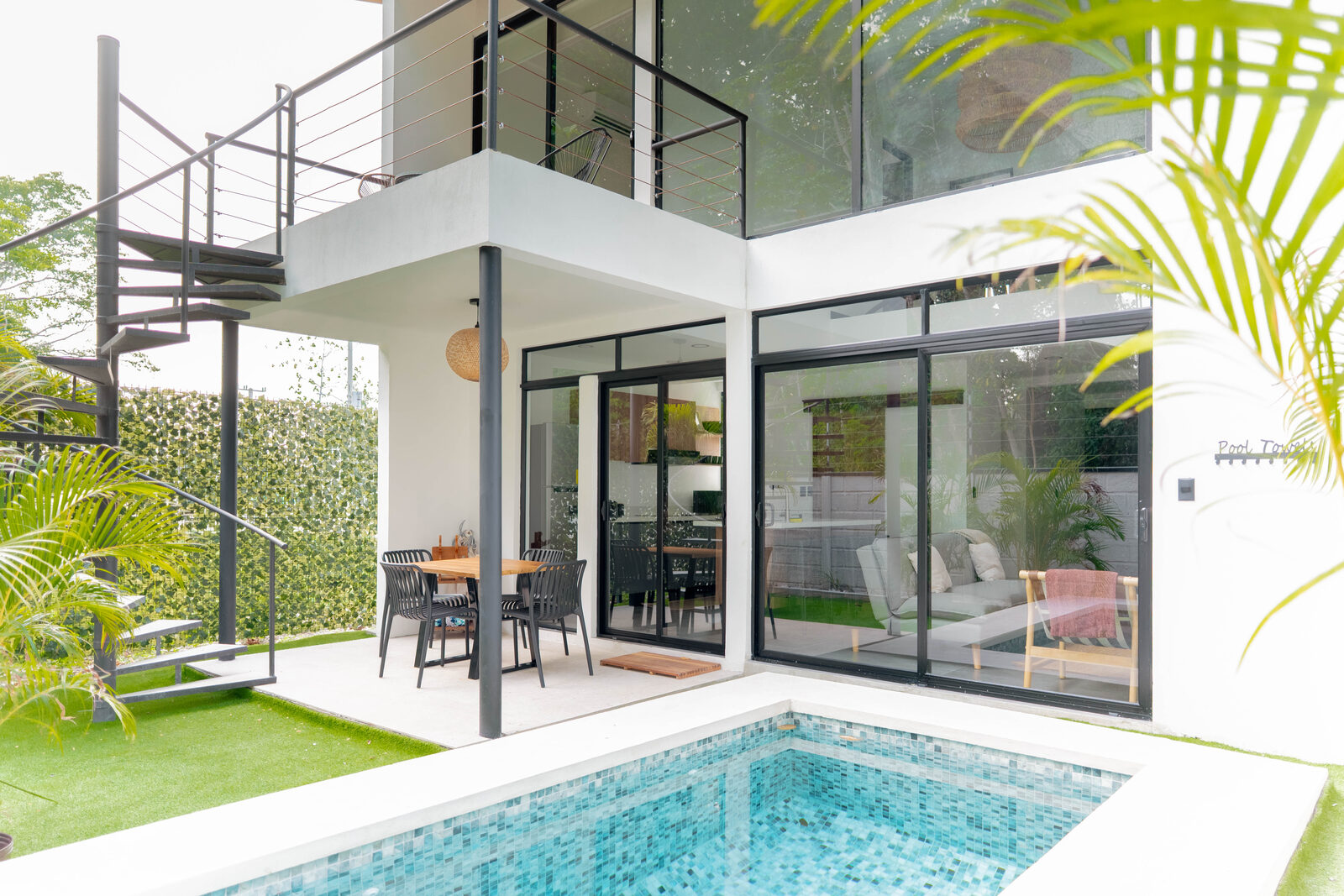
Costa Rica Real Estate Investment Guide for Vacation Rental Owners
You’ve been dreaming about it — a property in Costa Rica that pays for itself while you’re not there. A place where Pacific sunsets are the view from your terrace, and the rental income covers the mortgage (and then some).
Good news: Costa Rica real estate investment for vacation rental owners is more accessible than most people think. Foreigners have nearly the same property rights as citizens, the tax structure is surprisingly favorable, and demand for high-end vacation rentals keeps climbing.
But “accessible” doesn’t mean “simple.” There are legal nuances, regional differences, and operational realities that separate a great investment from an expensive headache.
Looking for our comprehensive guide? This blog post covers vacation rental investment fundamentals. For a deeper dive into the market, yields by region, exit strategies, and investor considerations, see our complete Costa Rica real estate investment guide.
This guide covers what you actually need to know.
Can Foreigners Buy Property in Costa Rica?
Yes — and this is where Costa Rica stands apart from much of Latin America.
Foreigners enjoy the same property ownership rights as Costa Rican citizens. You don’t need residency, a special visa, or a local partner. You can purchase property on a tourist visa using only your passport (TheLatinvestor, 2025).
There’s one important exception: the Maritime Zone. Properties within 200 meters of the high-tide line fall under the Maritime Zone Law (Ley de Zona Marítima Terrestre). The first 50 meters is public land — no one can build there. The next 150 meters requires a government concession, and foreign ownership is restricted to 49% unless you’ve been a Costa Rican resident for at least five years (TheLatinvestor, 2026).
Practical takeaway: Most desirable vacation rental properties — especially condos in developments like Los Sueños Resort or beachfront communities in Tamarindo — are titled properties outside the Maritime Zone. But always verify with a local attorney before signing anything.
What Does It Cost to Buy? Taxes, Fees, and Closing Costs
Costa Rica’s transaction costs are moderate compared to other markets. Here’s what to budget:
- Transfer tax: 1.5% of the registered property value
- Notary and legal fees: Typically 1–2% of the purchase price
- Registry fees: ~0.5%
- Total closing costs: Expect roughly 3–4% of the purchase price (Coldwell Banker Sunset Reef Realty)
Ongoing annual costs:
- Property tax: 0.25% of the assessed value — remarkably low by international standards
- Luxury tax (Impuesto Solidario): Applies to properties valued above ~$233,900 USD, with rates from 0.25% to 0.55% (Sol Realty, 2025)
- Corporation fees: If you hold property through a Costa Rican corporation (S.A.), annual fees range from $120–$380
- Rental income tax: A flat 15% on 85% of gross rental income. Maintenance, repairs, and mortgage interest are deductible
- VAT on vacation rentals: 13% on short-term rental income, which you collect from guests and remit to the tax authority
The investor residency threshold sits at $150,000 USD (established by law and unchanged for 2026), which grants temporary residency if you invest that amount in Costa Rican real estate (TheLatinvestor, 2026).
ROI Expectations: What Can You Actually Earn?
Let’s talk numbers. Vacation rental returns in Costa Rica vary significantly by region, property type, and management quality — but here are realistic benchmarks:
- Coastal vacation rentals: Net cap rates typically range from 6% to 10%, depending on location, occupancy, and management efficiency (Century 21 Costa Rica, 2026)
- Property appreciation: Coastal areas have seen 4–8% annual appreciation in recent years, with prime locations like Nosara and southern Guanacaste outperforming
- Occupancy rates: Well-managed luxury properties in peak markets regularly achieve 65–80% annual occupancy
The key variable? Management. A professionally managed property with strong listings, dynamic pricing, and genuine guest service will dramatically outperform a self-managed one. That’s not a sales pitch — it’s math. Properties with Superhost status on Airbnb earn up to 60% more revenue than comparable listings without it.
Regional Comparison: Where Should You Buy?
Not all Costa Rican markets are created equal. Here’s how the main vacation rental regions compare:
Jacó & Herradura
- Profile: Most accessible beach town from San José (1.5 hours). Established tourism infrastructure.
- Price range: $150K–$500K for condos; $400K+ for homes
- Strengths: Year-round demand, strong domestic tourism, growing expat community
- Best for: Entry-level investors, consistent occupancy over maximum nightly rates
Los Sueños Resort & Marina
- Profile: The premier luxury resort community on the Central Pacific coast. Gated, with a world-class marina and golf course.
- Price range: $350K–$2M+
- Strengths: Built-in demand from sport fishing and golf tourism, high ADR, resort infrastructure
- Best for: Investors targeting high-end guests and premium nightly rates
Tamarindo & Guanacaste Coast
- Profile: Northern Pacific. International airport nearby (Liberia). Well-known surf and beach destination.
- Price range: $200K–$800K for condos; $500K+ for homes
- Strengths: International visitor base, strong high-season demand (December–April), established rental market
- Consideration: More seasonal — high season is exceptional, but low season requires smart pricing
Nosara & Santa Teresa
- Profile: Wellness and surf lifestyle markets. Increasingly popular with digital nomads and mid-term renters.
- Price range: $300K–$1M+
- Strengths: Rapid appreciation, premium guest demographics, strong brand appeal
- Consideration: More remote, higher construction costs, limited inventory drives prices up
Manuel Antonio & Dominical (Southern Pacific)
- Profile: National park tourism (Manuel Antonio) and emerging surf culture (Dominical/Uvita).
- Price range: $200K–$700K
- Strengths: Year-round tourism, nature-focused guests tend to book longer stays
- Best for: Nature-oriented properties, eco-luxury positioning
Questions Every Investor Should Ask
Before you wire any money, get clear answers to these:
1. Is the property titled or in the Maritime Zone?
Titled property gives you full ownership rights. Maritime Zone concessions are more complex and restrict foreign ownership. Know which you’re buying.
2. What are the realistic annual operating costs?
Beyond mortgage payments, budget for property management (typically 20–35% of gross revenue), HOA fees, insurance, maintenance, utilities, and taxes. A good property manager will provide a detailed pro forma.
3. Do I need a Costa Rican corporation to buy property?
Not required, but many investors use an S.A. (Sociedad Anónima) for liability protection and easier future transfers. Consult a local attorney on the best structure for your situation.
4. How does rental income taxation work for non-residents?
Non-resident property owners pay a flat 15% tax on 85% of gross rental income. You must issue electronic invoices and file monthly. A local accountant is essential — penalties for non-compliance can reach 10x the tax owed (Sol Realty, 2025).
5. What occupancy rate do I need to break even?
This depends entirely on your purchase price, financing, and operating costs. As a rough benchmark, most vacation rental investments in Costa Rica need 45–55% occupancy to cover all expenses.
6. Should I furnish the property myself or hire a designer?
For vacation rentals, presentation directly impacts revenue. Professional staging and photography aren’t luxuries — they’re investments with measurable returns. Your property manager should guide this.
7. How do I choose the right property manager?
Look for transparent reporting, dynamic pricing expertise, strong guest reviews, and a track record in your specific market. The difference between an average manager and a great one can be 30–50% in annual revenue.
The Bottom Line
Costa Rica real estate investment for vacation rental owners offers a rare combination: strong legal protections for foreigners, favorable tax treatment, growing tourism demand, and genuine lifestyle appeal. The numbers work — especially when you pair the right property with professional management.
But every successful investment starts with due diligence. Hire a reputable Costa Rican real estate attorney. Get an independent property appraisal. Understand your tax obligations. And partner with a management company that treats your property like the asset it is.
Ready to understand what your Costa Rica property could actually earn? Explore our rental income resources for a realistic picture of vacation rental revenue on the Central Pacific coast.
Nest Stays provides full-service vacation rental management for luxury properties in Costa Rica’s Central Pacific region. Have questions about buying or managing a vacation rental property? Get in touch — we’re happy to share what we know.
Frequently Asked Questions
Can foreigners buy property in Costa Rica?
Yes, foreigners enjoy the same property ownership rights as Costa Rican citizens. You don’t need residency, a visa, or a local partner—just a passport. The exception is the Maritime Zone (within 200 meters of the high-tide line), where the first 50 meters is public land and the next 150 meters requires a government concession with foreign ownership restricted to 49% unless you’re a 5+ year resident. Most desirable vacation rentals are titled properties outside the Maritime Zone.
What are the taxes and fees when buying property in Costa Rica?
Closing costs total 3-4% of purchase price: 1.5% transfer tax, 1-2% notary/legal fees, and ~0.5% registry fees. Annual ongoing costs include property tax (0.25% of assessed value), luxury tax for properties above $233,900 (0.25-0.55%), and corporation fees if holding through an S.A. ($120-380/year). Rental income tax is a flat 15% on 85% of gross income, plus 13% VAT collected from guests.
What is the ROI on vacation rental property in Costa Rica?
Coastal vacation rentals typically achieve net cap rates of 6-10% depending on location, occupancy, and management quality. Property appreciation in coastal areas has been 4-8% annually, with prime locations like Nosara and southern Guanacaste outperforming. Well-managed luxury properties regularly achieve 65-80% annual occupancy. Professional management dramatically impacts returns—Superhost properties earn up to 60% more revenue than comparable listings. Most investments need 45-55% occupancy to break even.
What's the best region to buy vacation rental property in Costa Rica?
Best regions by profile: Jacó & Herradura ($150k-$500k) for entry-level investors and consistent year-round occupancy. Los Sueños Resort ($350k-$2M+) for luxury market with fishing/golf tourism. Tamarindo/Guanacaste ($200k-$800k) for international visitors but more seasonal. Nosara/Santa Teresa ($300k-$1M+) for rapid appreciation and premium demographics. Manuel Antonio/Dominical ($200k-$700k) for year-round nature tourism. Choice depends on your budget, target market, and investment strategy.
Do I need a Costa Rican corporation to buy property?
No, a corporation is not required to buy property in Costa Rica—foreigners can purchase directly with just a passport. However, many investors use a Sociedad Anónima (S.A.) for liability protection and easier future transfers. Annual S.A. fees run $120-380. Consult a local attorney on the best ownership structure for your specific situation. Properties over $150,000 can qualify for investor residency status.
Ready to Experience Costa Rica Real Estate Investment Guide for Rentals?
Book your Costa Rica vacation rental with Nest Stays and make this your base for it all.